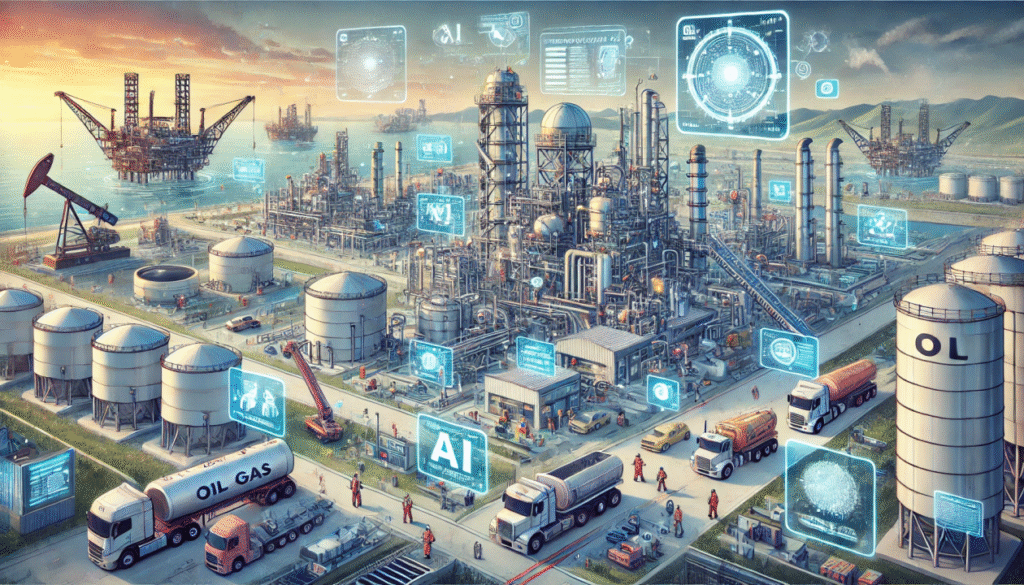
Artificial Intelligence (AI) is no longer a futuristic concept, it’s now a fundamental driver of innovation in the global energy industry. From forecasting commodity prices to optimizing drilling operations, AI is transforming how companies manage risk, allocate capital, and deliver efficiency across complex value chains.
In today’s volatile market environment shaped by geopolitical uncertainty, fluctuating oil prices, and decarbonization pressures the ability to anticipate and adapt quickly is invaluable. That’s where AI steps in.
Predicting Prices: AI in Market Forecasting
Energy markets are notoriously volatile. Traditional forecasting models rely heavily on historical data and linear assumptions, which often fail to capture sudden disruptions such as sanctions, supply chain crises, or geopolitical conflicts.
AI-powered systems, however, excel at identifying nonlinear relationships and detecting early signals of change. By analyzing massive datasets from satellite imagery of storage tanks to real-time shipping data and macroeconomic indicators AI can provide near-instant insights.
Use Cases
Oil price prediction: Algorithms track vessel movements, OPEC+ announcements, and refinery output to project short-term price shifts.
Natural gas demand forecasting: AI integrates temperature data, industrial activity, and global LNG trade flows to model consumption patterns.
In recent years, energy traders have adopted deep-learning models that can predict Brent and WTI price movements up to 72 hours in advance with remarkable accuracy, outperforming human analysts by 15–25%.
Managing Risks with Machine Learning
Energy companies face a multitude of risks operational, financial, and environmental. Machine learning enables firms to detect anomalies, simulate outcomes, and manage exposure more effectively.
Risk Type
AI Application
Benefit
Operational
Predictive maintenance of drilling equipment
Reduces downtime by up to 30%
Financial
Price volatility modeling
Enables better hedging strategies
Environmental
Leak and emission monitoring via sensors
Enhances compliance and safety
Geopolitical
Automated news sentiment analysis
Anticipates disruption risks
By leveraging these tools, companies can shift from reactive risk management to predictive and preventive strategies, saving millions in potential losses.
Boosting Efficiency Across Operations
AI isn’t just improving forecasting and risk management, it’s revolutionizing operational efficiency across the energy value chain.
Upstream Exploration and Production
AI seismic interpretation accelerates reservoir discovery and reduces drilling errors.
Autonomous drilling systems optimize parameters in real time, lowering costs and improving safety.
Midstream Logistics
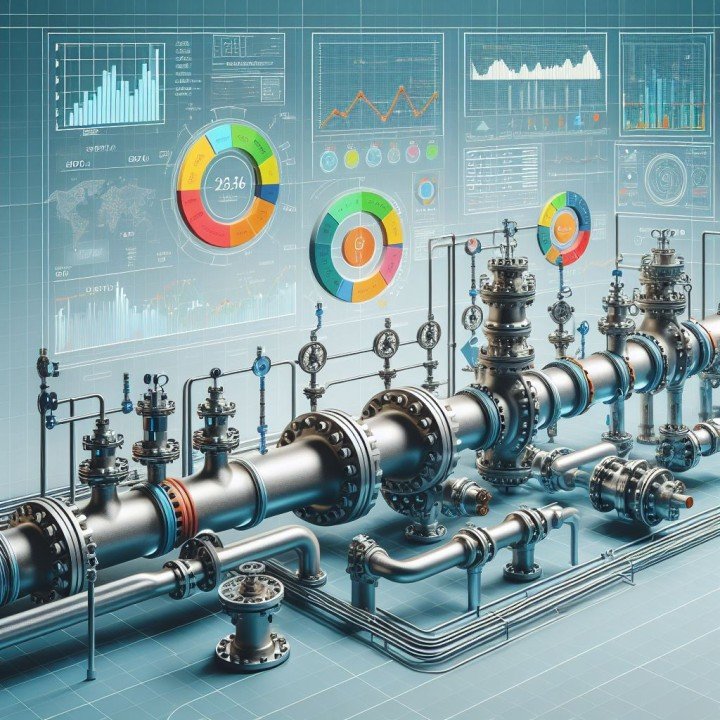
Pipeline monitoring algorithms detect micro-leaks and corrosion long before human inspectors can.
AI-driven routing software enhances crude and LNG transport efficiency.
Downstream Refining
Refineries are adopting AI-driven digital twins virtual replicas of operations that allow real-time simulation and optimization.
This technology can reduce energy consumption and improve product yields by up to 8–10%.
AI in Renewable and Low-Carbon Energy
The transition to renewables introduces variability and complexity. AI enables smarter integration of solar, wind, and hydrogen into the grid.
Solar forecasting models use satellite imagery to predict output fluctuations caused by cloud cover.
Wind energy algorithms analyze turbine data to maximize uptime and minimize wear.
Hydrogen optimization tools help determine when to produce, store, or transport based on energy price signals.
In the future, AI will become a cornerstone of smart grids, self-regulating systems that autonomously balance energy generation and demand.
Challenges in AI Adoption
While AI offers enormous potential, its integration is not without challenges:
Data fragmentation: Energy companies often operate across silos, limiting unified analytics.
Cybersecurity risks: AI systems connected to critical infrastructure can be targets for attacks.
Ethical and regulatory issues: Questions about data privacy and algorithmic transparency persist.
Skill gaps: The industry still faces a shortage of professionals who can blend energy expertise with data science.
To unlock AI’s full potential, companies must invest in data governance, cybersecurity frameworks, and workforce reskilling.
The Future: From Prediction to Autonomy
The ultimate frontier for AI in energy lies in autonomous systems where machines make decisions without human intervention.
AI-powered trading bots will execute real-time arbitrage across oil, gas, and power markets.
AI-integrated carbon tracking will allow companies to optimize emissions performance dynamically.
By 2030, analysts estimate that AI could add more than $300 billion in value to the global energy sector, primarily through automation and predictive analytics.
AI is reshaping the global energy industry from the ground up. It helps predict prices before volatility strikes, manage risks before crises unfold, and improve efficiency across every stage of the supply chain.
As markets become more complex and interconnected, data-driven intelligence will become the ultimate competitive advantage. Energy companies that master AI’s potential will not only navigate uncertainty, they’ll define the next era of growth and resilience in global energy.